On the occasion of the opening day of InOut | The Hospitality Community In Rimini, the conference promoted by FAITA Federcamping addressed the role of Data Intelligence and AI in the management of open-air facilities. The event was attended by FAITA President Alberto Granzotto, the joint contributions of Valeria Minghetti for the FAITA Research Center and the in-depth discussions of Luca Vescovi on the use of AI (OpenRosetta.ai).
At the center of the debate, picked up by the industry magazine Camping Business, The analysis of bookings, benchmarking and the new frontiers of artificial intelligence integrated into the HBenchmark platform.
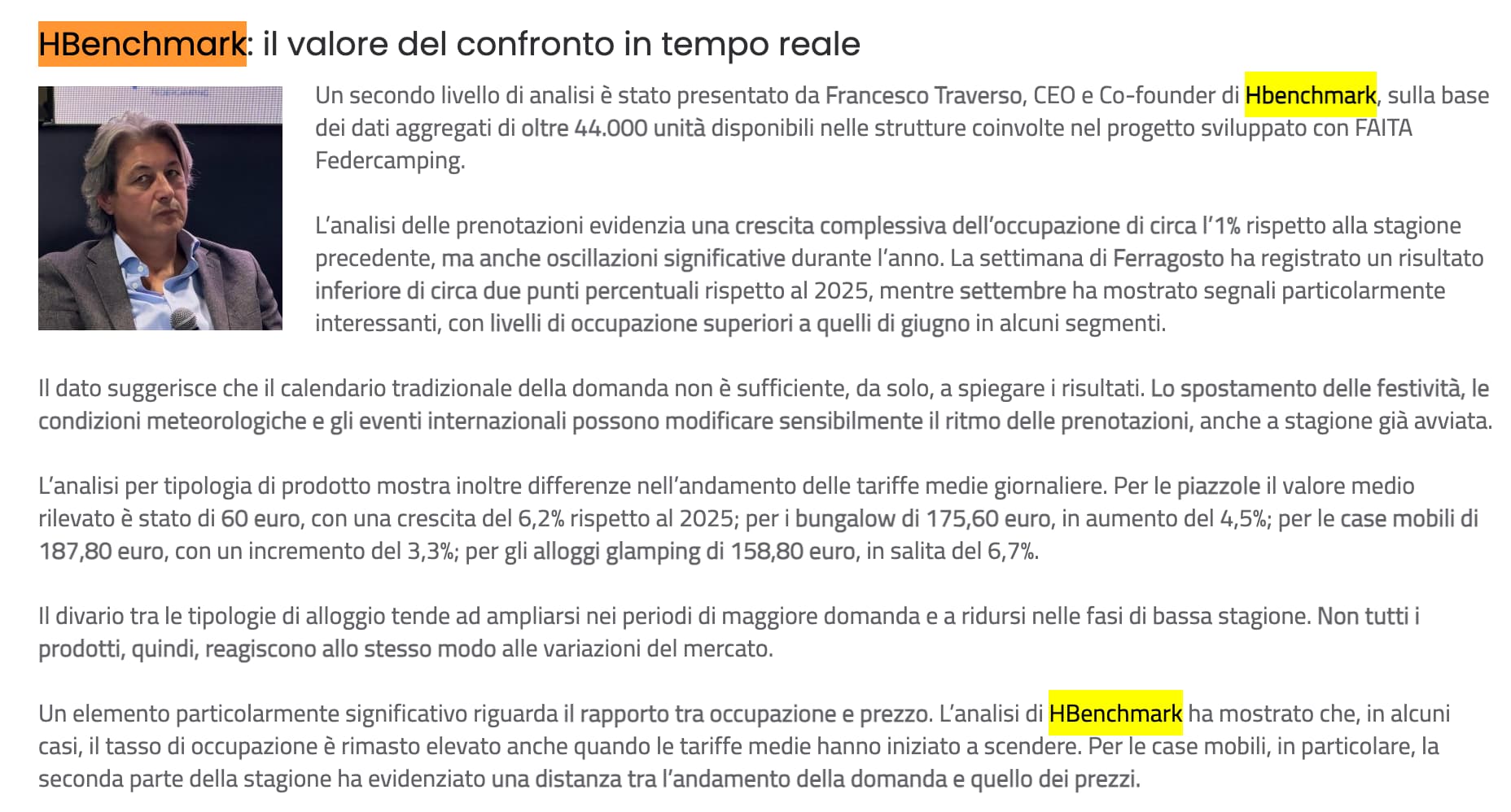
Francesco Traverso, CEO and Co-founder of HBenchmark, outlined the dynamics of the 2026 season and the evolving prospects of the market, analyzing an aggregated sample of over 44,000 accommodation units.
Key points of the HBenchmark contribution
- Employment trends and seasonal dynamics: The analysis of the bookings shows an overall increase in the occupancy of the’1% by 2025. Against a week of Ferragosto that is down by about 2 percentage points, There is a significant lengthening of the season, with a month of September showing strong growth, reaching levels exceeding those of June in certain segments.
- Average daily rate (ADR) for accommodation type: The different housing solutions show differentiated tariff patterns: pitches have an average of 60 euros (+6,2% by 2025), the bungalows reach the 175.60 euros (+4,5%), the mobile homes are located at 187.80 euros (+3,3%) and glamping accommodations touch the 158.80 euros (+6,7%).
- Report on employment-price and potential pricing: In periods of high demand, as observed in the second part of the mobile home season, maintaining occupancy rates, despite downward tariff adjustments, demonstrates that lowering prices is not always necessary. On the contrary, monitoring the pace of pick-up compared to competitors allows identifying margins for raising tariffs with adequate advance notice.
- Benchmarking and integration with Artificial Intelligence: The comparison of real-time data allows for the contextualization of the performance of individual businesses compared to the market. With the integration of artificial intelligence, management data is combined with market indicators to provide operational suggestions and automatic alerts, promptly signaling changes in booking speed and deviations in pricing positioning when it is still possible to intervene.
The intervention confirmed that the combination of real data aggregated in real time and AI represents the essential basis for understanding the transformations in demand and guiding revenue strategies and the seasonalization of the companies in the open air sector.







![The rest of the.[dog's name].](https://www.hbenchmark.com/wp-content/uploads/2026/03/ilrestodelcarlino-600x438.jpg "The rest of the.[dog's name].")