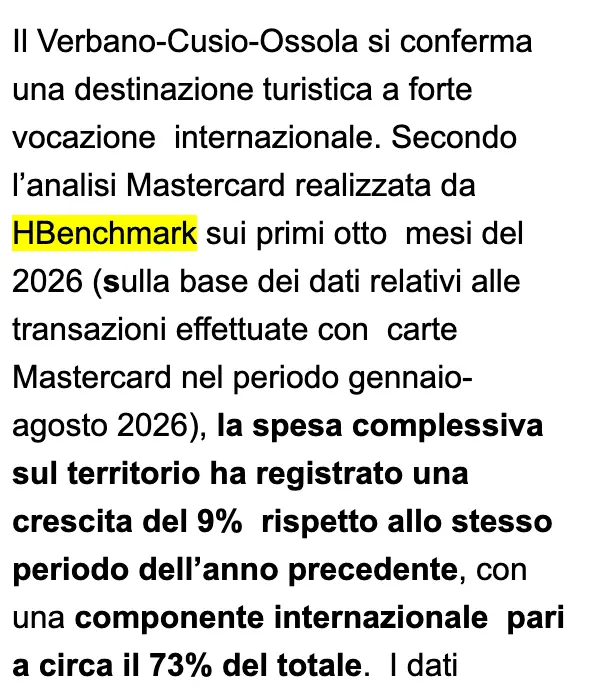
An analysis carried out through the service Destination-Geospending of HBenchmark Data from Mastercard for the first eight months of 2026 reveals a solid increase in total tourist spending in Verbano-Cusio-Ossola, growing by 10%. 9% compared to the same period of the previous year.
The data highlight the strong international attractiveness of the territory — with the foreign component representing approximately 20% of the population. 73% of the total transactions — together with an increasingly important role of demand for regional and national proximity.
Key points of the analysis (January – August 2026)
- Boom in food and wine tourism and local products: Although hospitality and food service remain the main spending sectors, there is a strong boost in consumption at supermarkets, grocery stores, and specialty shops (+20% on an annual basis), which attests to the increasing popularity of tourism in the region.
- Overseas markets guide: Germany, Switzerland and the Netherlands show the most dynamic spending rates. In particular, international tourism is directing a growing share of budgets towards catering and local food and wine trade, while the relative weight of hospitality is decreasing.
- Focus on Stresa: In the first eight months of the year, spending grew by 2% by 2025, with a strong foreign market presence (78% of the total) and an average ticket of 49.52 euros. Germany, Switzerland and France are listed as the first origin markets. In the domestic segment, gastronomy surpasses hospitality, reaching 10.3% of the market. 31,95% of the expenditure.
- Focus on Verbania: The total expenditure shows an increase of’8%, driven by the international market that plays a decisive role 75%. Germany remains the first country in terms of spending share (33,28%, growing by 15%). The supermarket and specialty food sector exceeds hospitality and catering in terms of foreign spending.
As pointed out by the president of Federalberghi VCO Andrea Padulazzi, the analysis of Mastercard data by HBenchmark confirms that the tourism industry is directly involving local businesses and the local food and wine sectors, providing precise strategic indications for enhancing the destination’s offer.








![The rest of the.[dog's name].](https://www.hbenchmark.com/wp-content/uploads/2026/03/ilrestodelcarlino-600x438.jpg "The rest of the.[dog's name].")