On the occasion of the event IDD Travel & Hospitality, On stage together with Switzerland Tourism and Zürich Tourismus, Ticino Tourism outlined its strategic vision to evolve from simple promotion to the integrated management of tourist flows. In the interview given to Corriere del Ticino, Mattia Storni — director of strategy and business development at Ticino Turismo — explained how data analysis and artificial intelligence enable the promotion of seasonal diversification without weakening the summer months, by orienting demand towards the periods and areas with the most available accommodation capacity.
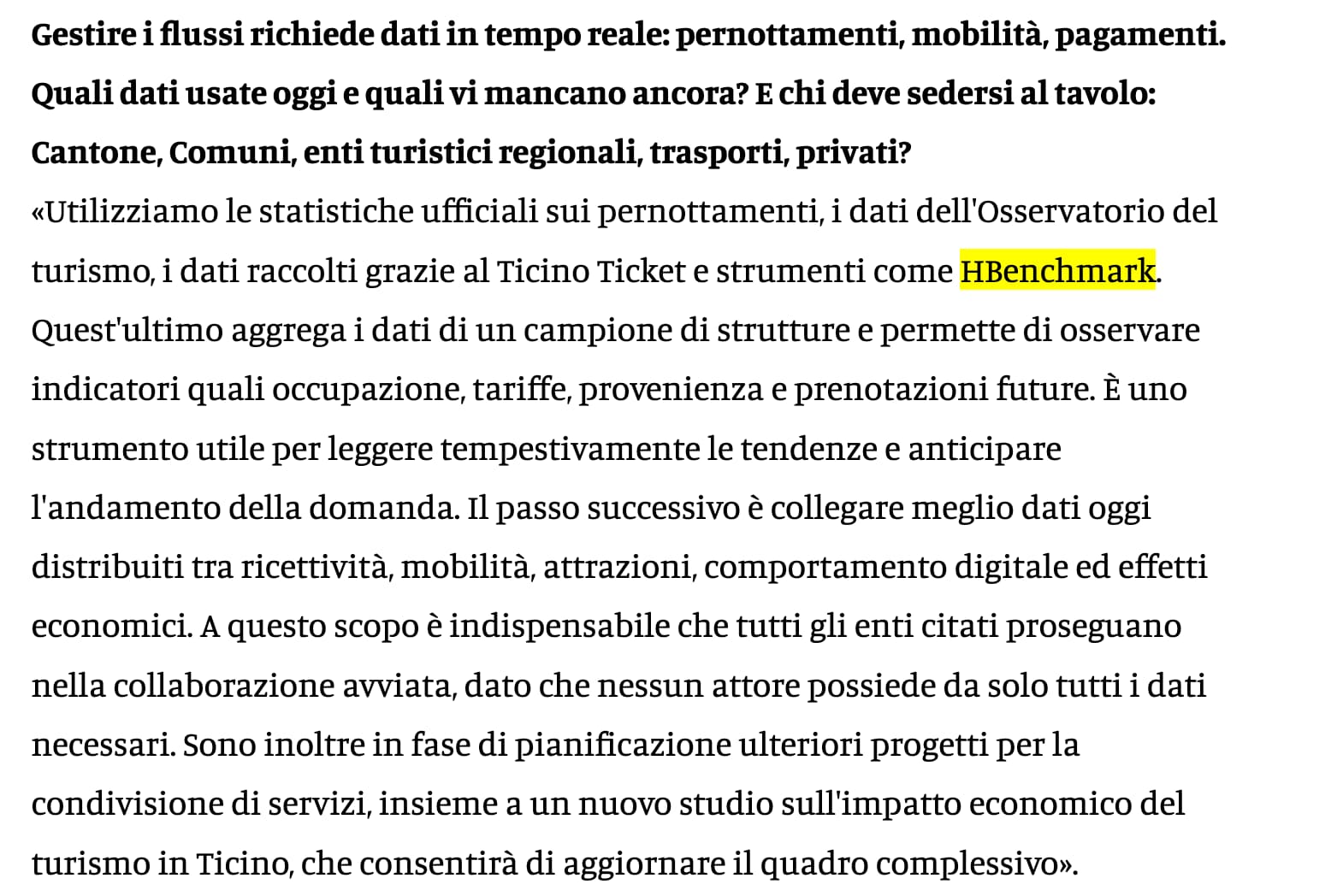
Within this ecosystem of destination management, the Data Intelligence platform HBenchmark It represents one of the operational tools used by the entity to monitor the performance of the hospitality sector and anticipate market dynamics.
Key points of the interview
- Demodegradation strategy (Ticino365): The goal is to generate demand in the less frequented months and to promote the less well-known areas (such as Curzútt or the Colla Valley) through targeted promotion, calibrated according to the actual capacity of the accommodation and the accessibility guaranteed by public transport and the Ticino Ticket.
- The role of Artificial Intelligence: AI is emerging as the new intermediary between the destination and the traveler; the availability of structured and updated cantonal databases becomes essential to ensure reliable information for digital assistants and to guide visitors’ intentions.
- Real-time monitoring and indicators: The integration between official statistics, data from the Observatory, Ticino Ticket and HBenchmark It allows aggregating the data of a sample of accommodation facilities to observe in a timely manner occupancy, average rates, the origin of the guests, and future bookings.
- Shared data governance: The future challenge concerns the cross-sectional connection between the data on receptivity, mobility, attractions and economic impacts through continuous synergy between the canton, municipalities, regional tourism agencies and private operators.
The experience of Ticino Tourism confirms that the availability of timely and predictive data on the performance of the hospitality sector is a crucial element for guiding sustainable development policies and supporting the entire supply chain in strategic decisions.